Choosing design support
Design Subscription Vs Hiring A Designer.
Both options can give a business excellent creative support. The right choice depends on the work you need, the team you have, and how predictable your design workload really is.
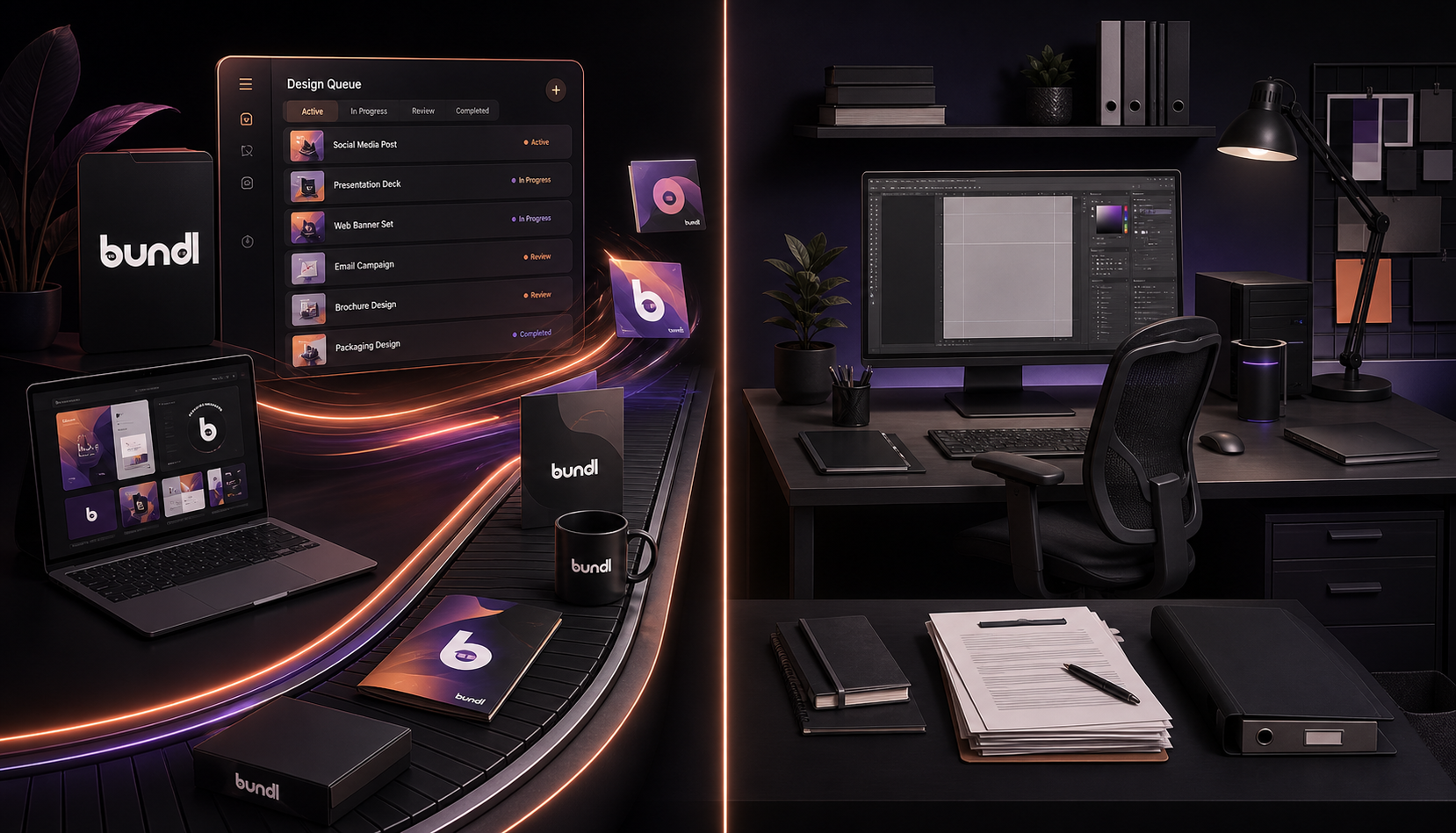
At some point, a growing business usually reaches the same awkward stage: design work is arriving too regularly to handle casually, but it is not obvious whether the answer is to hire a designer or use an ongoing design subscription.
There is no universal winner. A good in-house designer can become an invaluable part of a business. A good design subscription can give a team broader creative support with less commitment and management. The useful question is not “which option is better?” It is “which option fits the way our business actually works?”
The quick answer
A design subscription is often the better fit when you need a varied stream of professional design work, want predictable costs, and do not yet need one designer embedded in the business every working day.
Hiring an in-house designer is often the better fit when there is enough consistent work to occupy them full-time, they need deep daily access to your team, and the business is ready to recruit, manage and develop that person properly.
A useful starting point
If your design list changes every week and covers several formats, a subscription gives you flexibility. If the role itself is clear, consistently full and central to daily operations, hiring may make more sense.
Comparing the real costs
Salary is the most obvious cost of hiring, but it is not the full cost. An employed designer also needs recruitment time, employer contributions, pension, paid leave, software, equipment, training and management. A more experienced designer may reduce the need for creative oversight, but naturally costs more.
A design subscription normally has a fixed monthly price. Software, equipment and employment overheads sit with the provider. This makes the cost easier to forecast and means the service can usually begin much faster than a recruitment process.
However, comparing price alone can be misleading. If your business genuinely has enough suitable work for a designer every day, an in-house hire can deliver excellent long-term value. If demand rises and falls, or the work requires several different design skills, paying for one permanent role may be less efficient.
Capacity, range and specialist skills
An in-house designer gives you a known amount of capacity. Their time belongs to your business, which is useful when requests are frequent, urgent and closely connected to internal teams. The limitation is that one person still has one set of strengths and one working week.
A designer who is excellent at brand identity may be less confident with presentation design, digital advertising or packaging. That is completely normal. Creative roles are broad, and finding one person who is equally strong at everything is difficult.
A design subscription can provide access to a wider mix of skills because work can be matched to different people within a team. It is particularly useful when one week involves social graphics and the next involves a brochure, landing page and pitch deck.
The trade-off is active capacity. A subscription works through an organised queue, so it should not be mistaken for an unlimited number of designers working simultaneously. A transparent provider will explain how many requests can be active and what turnaround to expect.
Management, communication and continuity
An employee needs direction, feedback, support and career development. When managed well, an in-house designer develops a deep understanding of the business and can contribute far beyond individual briefs. They hear conversations, spot opportunities and build strong relationships across the team.
That closeness is a major benefit, but it requires somebody internally who has the time and confidence to manage creative work. Hiring a designer without a clear process or good briefs does not automatically solve design problems.
A design subscription reduces much of the employment and workflow management. Requests, priorities and feedback are usually handled through a shared portal, with an account manager or creative lead helping keep work moving. A consistent subscription team can still learn your brand deeply over time, although they will not have the same daily internal exposure as an employee.
When does a design subscription make more sense?
An ongoing design service is often a strong choice when:
- Your business needs design every month, but not necessarily every hour of every day.
- The work covers a broad mix of marketing, brand, digital and print formats.
- Your workload changes around launches, campaigns and busy periods.
- You want to begin quickly without recruiting and onboarding an employee.
- Your team wants a clear request queue and predictable monthly budget.
- You need professional creative support but do not have an internal creative manager.
It can also work well before hiring. A subscription helps a business understand how much design it really needs, which requests appear most often and what skills a future employee would require.
When does hiring an in-house designer make more sense?
Hiring is usually worth serious consideration when:
- You can confidently fill a designer's week with suitable work.
- The designer needs to join daily meetings and respond immediately to internal changes.
- Your product or service is complex and requires constant specialist knowledge.
- You want design to become a deeply embedded internal capability.
- You have someone who can lead, manage and develop the designer effectively.
- The business is ready for the financial and practical commitment of employment.
The best in-house designers do much more than complete a task list. They shape ideas, improve systems and influence how the organisation communicates. If that is the role you need and can support, hiring can be the right investment.
Could you use both?
These options are not mutually exclusive. Many internal designers and marketing teams use external support when capacity is stretched or specialist skills are needed. A subscription can handle recurring production work while an in-house designer focuses on strategy, high-priority campaigns and internal collaboration.
This can be a healthier model than expecting one employee to manage every creative request alone. It gives the internal designer room to do their best work while providing the business with extra capacity when needed.
How to make the right decision
Look at the last three months of design requests rather than guessing about the future. List the tasks, how often they appeared, which skills they needed, how urgent they were and who managed them. Then ask:
- Is there enough consistent work for a full-time role?
- Does the work suit one designer's likely skill set?
- Do we need daily internal availability or dependable ongoing delivery?
- Who would manage an employee and guide their creative development?
- How much flexibility do we need if priorities or budgets change?
The honest answer
Choose the option that removes the most friction from your real workflow. The right model should help good design happen more consistently, not simply look cheaper on paper.
Finding the right design support
A design subscription is not a replacement for every in-house designer, and hiring is not automatically the next step for every growing company. Both can work brilliantly when the need is clear.
At bundl, we provide monthly graphic design support for UK businesses that need reliable creative capacity without hiring another full-time team member. Explore how our unlimited graphic design service works, compare design subscription plans, or tell us what your current design workload looks like and we will give you an honest view.