AI and design subscriptions
AI Design Tools Vs A Better Design Subscription.
AI can make first drafts, exploration and production faster. But when a business needs stronger campaigns, a consistent brand and work that feels specific, human judgement is still the part that makes design valuable.
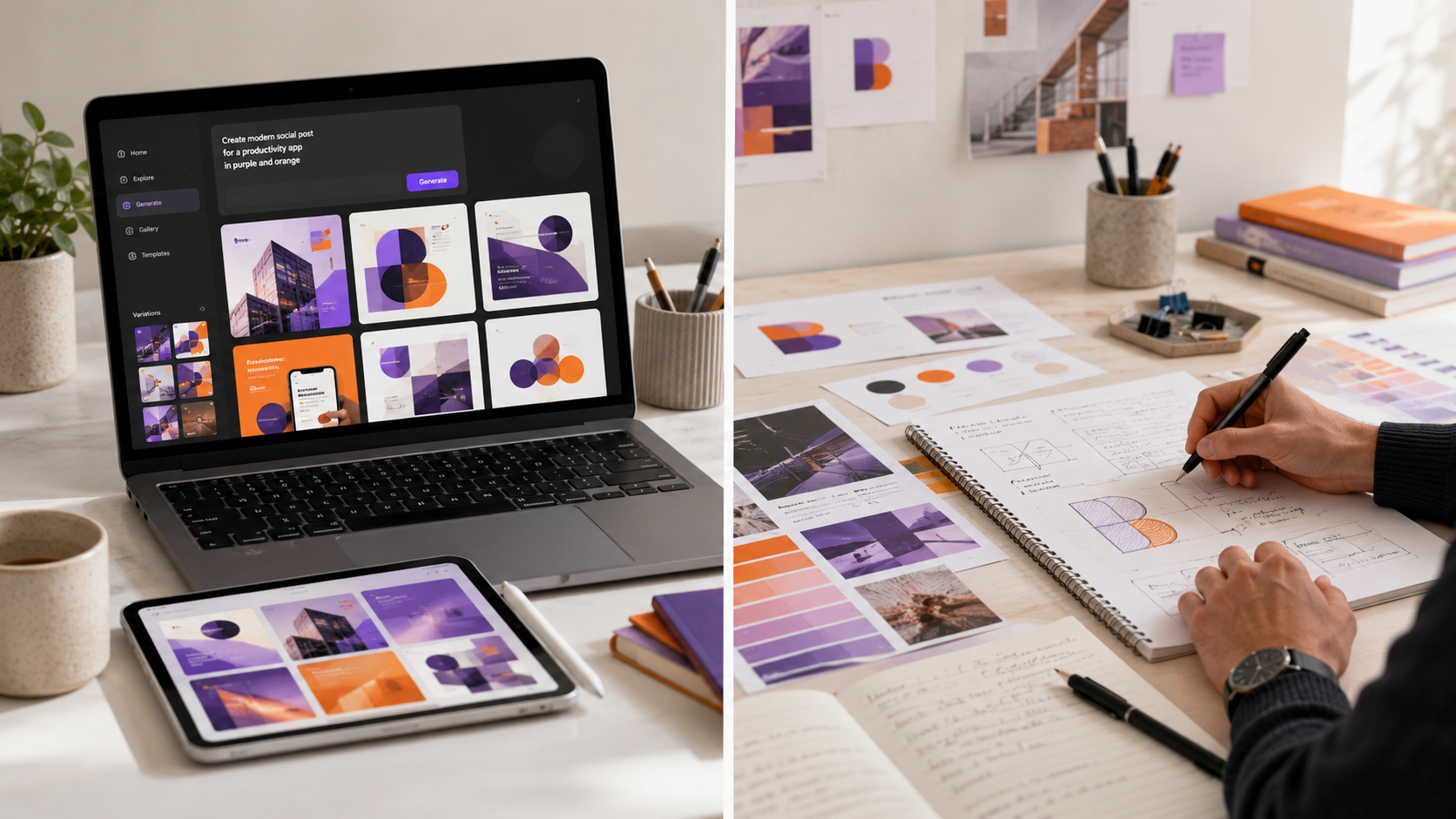
AI graphic design tools have moved quickly. A business can now type a prompt and get a logo concept, poster, social post, advert image or website mockup in seconds. That is impressive. It is also why a lot of businesses are asking the same question: do we still need a human designer?
The answer is yes, especially if the design has to represent your brand, persuade real customers or last longer than a quick internal mockup. AI can be a useful tool, but it still needs creativity fed into it. It needs taste, context, judgement and someone who knows what the business is trying to say. Those are human jobs.
The quick answer
AI graphic design is useful for speed, rough ideas, moodboards and early visual exploration. A human designer is better for brand identity, campaign thinking, layout, consistency, originality, production quality and decisions that need commercial judgement.
If you only need a quick placeholder image, AI may be enough. If the work is customer-facing, brand-sensitive or part of a bigger marketing system, a human designer is usually the safer and stronger choice.
The simple version
AI can generate design-looking things. A human designer creates design that fits the business, the audience, the brief and the moment.
What can AI graphic design actually do?
AI design tools can create images, suggest layouts, remove backgrounds, expand pictures, generate visual ideas, resize assets and produce variations quickly. Used well, that can save time in the early stages of a project.
For example, AI can help a designer explore a mood, test a visual route, create a rough concept image or speed up repetitive production. It can also help small teams get something on the page when they are staring at a blank screen.
But there is a difference between output and design. Output is what the tool gives you. Design is the thinking behind what should exist, why it should look that way, how it should behave across formats and whether it supports the business properly.
The pros of AI graphic design
AI is fast
This is the obvious benefit. AI can create a large number of visual options quickly. If you need to explore styles, gather references or test the direction of an idea, that speed can be genuinely useful.
AI can be cost-effective for rough work
For early-stage thinking, internal mockups or temporary visuals, AI may reduce the cost of getting started. It can help teams communicate an idea before proper design work begins.
AI can support variation
Once a direction is clear, AI tools can help produce crops, image extensions or alternative visual routes. In the right workflow, that can make production quicker.
AI can help non-designers explain what they mean
Some clients find it hard to describe a visual idea. AI-generated references can sometimes help them say, "a bit like this, but calmer" or "this is close, but too generic." That can make a brief easier to discuss.
The cons of AI graphic design
AI design can look similar
One of the biggest problems with AI graphic design is sameness. Many tools are trained to produce what looks statistically likely, polished and familiar. That often means smooth gradients, glossy 3D objects, perfect-looking people, predictable tech imagery and layouts that feel like they came from the same visual soup.
This is already why so many businesses look alike online. The same style of generated image appears in pitch decks, social posts, adverts and landing pages. It may look fine for a second, but it rarely gives a brand something distinctive to own.
AI does not understand your business like a person can
AI can respond to a prompt, but it does not sit in the meeting, hear the hesitation in a client's voice, understand why one product matters more than another, or notice that the sales team keeps explaining the same point to customers.
Good design often comes from those messy details. It comes from asking better questions, spotting what is missing and turning a vague business problem into a clear visual decision.
AI needs strong creative direction
AI is not magic. The quality of the output depends heavily on the quality of the input and the judgement used afterwards. If you feed it a weak brief, it will usually give you a polished version of a weak idea.
A human designer brings taste before, during and after the tool is used. They decide what to ask for, what to ignore, what to refine and when the work is not good enough yet.
AI can struggle with consistency
Brands need consistency across formats. A campaign might need social media design, ad creative, a brochure, a presentation, email banners and sales material. AI can generate individual images, but keeping a whole system coherent is much harder.
A human designer can build the rules: type hierarchy, spacing, colour use, image treatment, messaging emphasis and layout rhythm. Ongoing brand design support then applies those rules as new requests arrive. Without that system, you often end up with assets that look related only because they were made by the same tool.
AI can create legal and usage uncertainty
AI-generated work can raise questions around training data, copyright, ownership, originality and whether an output is safe to use commercially. The details depend on the tool, licence, country and use case, but the important point for businesses is simple: do not assume every generated image is automatically risk-free.
For low-risk internal use, that may not matter much. For a brand identity, packaging, campaign or hero image, it is worth being more careful.
Why human designers still matter
Human designers do not just make things look nice. They interpret a brief, challenge assumptions, organise information, spot weak ideas and make creative decisions that connect the brand to the audience.
A designer can ask:
- What is the business trying to be known for?
- Who is this design speaking to?
- What should the audience notice first?
- Does this look like the brand, or just like a trend?
- Will this work in print, social, presentation and web formats?
- Is this clear enough for someone who is not already close to the project?
That judgement matters. AI can give you options, but it cannot care about the outcome. It cannot protect the brand from drifting. It cannot tell a founder that the idea they like most is confusing. It cannot build trust with a marketing team over months of working together.
Good human design has a point of view. It has restraint. It knows when not to add more. It understands that the most useful answer is not always the flashiest one.
The brand risk: looking like everyone else
A lot of AI-generated design has the same problem as cheap templates: it gives you something that looks acceptable, but not something that feels specific. For a business, that can be quietly damaging.
If your graphics look like the same generic AI visuals your competitors are using, you lose one of design's biggest advantages. You become harder to recognise. Your social posts blend in. Your pitch deck feels familiar before anyone reads it. Your brand starts borrowing personality instead of building its own.
The real value of design is not decoration. It is distinction. It helps a business become easier to notice, understand and remember. That requires more than generating a good-looking image. It requires creative choices rooted in the brand.
A useful warning
If an AI graphic looks instantly impressive but could belong to almost any business in your category, it is probably not doing enough for your brand.
The best way to use AI in design
The strongest approach is not usually "AI or designer". It is a stronger design service that uses modern tools where they help, while still delivering the brand judgement and polish that businesses cannot get from a prompt alone.
AI can be useful for:
- early visual exploration and moodboards
- quick internal mockups
- background extension or image cleanup
- rough concept routes before final design
- generating reference material for discussion
- speeding up repetitive production tasks
AI is less suitable for:
- final brand identity without human creative direction
- logo marks that need to be ownable and legally safe
- campaign systems that need consistent rollout
- design work where accuracy, hierarchy and detail matter
- anything that needs a deep understanding of the audience
Think of AI as a tool in the studio, not the studio itself. A useful tool can still produce weak work if nobody with taste is guiding it.
How AI is changing the design subscription world
AI is changing what clients reasonably expect from a design subscription. Basic first drafts, rough variations and everyday production can happen faster than before, so “we make graphics quickly” is no longer a strong enough promise on its own.
The stronger offer is ongoing brand and design support: someone who knows what the business is trying to achieve, can decide which route is worth pursuing, and can keep the work consistent across social content, ads, sales decks, emails, web pages and print.
That is the difference between access to output and access to judgement. A good design subscription should make a growing business look more credible and more recognisable over time—not simply add more files to a folder.
What clients should expect now
Faster exploration and clearer first routes, combined with human creative direction, brand consistency, production-ready detail and honest advice when an idea needs rethinking.
AI graphic design vs human designer: which is better?
For a quick idea, AI can be better because it is fast. For a business that needs design to carry meaning, build trust and stay consistent, a human designer is better.
That does not mean AI has no place. It means AI should sit under human creative direction. The creativity still has to come from somewhere: the brief, the strategy, the brand, the designer's taste, the client's knowledge and the audience's needs.
AI can generate what already feels familiar. Human designers can decide when familiar is useful, when it is lazy, and when the business needs something braver.
The honest answer
AI can help make design faster. Humans make design meaningful. If your business needs to stand out, trust the human judgement first and use AI only where it genuinely supports the work.
What should your business do next?
If your team is already using AI, keep using it for rough thinking, references and low-risk support. But do not let it become the creative director of your brand. Someone still needs to decide what is right, what is original enough, what fits the audience and what will hold together across every channel.
At bundl, we provide ongoing graphic design support for UK businesses that need regular creative work without hiring in-house. We use modern tools where they genuinely speed up the process, while our designers focus on what clients actually need: polished campaigns, credible design, clear content and a consistent brand across every channel. We can help with social media design, ad creative, presentation design, brand design support and the everyday design jobs that need more than a generic output. See our monthly design plans or send us your current design list and we will help you shape the right approach.